What is Evolution? What does it mean to evolve?

Evolution of Dance
Scientist_________________Contribution


Carlous Linnaeus: A Swedish botanist scientist who classified organisms according to their similarities. "Father of Taxonomy". He was credited for creating a classification system forspecies (organisms that are closely related, can mate, and reproduce) which we still use today!

Georges Buffon: A French naturalist who proposed organisms came from related species and did not arise separately. He rejected the idea that the Earth was 6000 years old


Erasmus Darwin: An English doctor/poet (Charles Darwin's Grandpa) proposed all living things descended from a common ancestor.

Jean Baptiste Lamarck: A French Naturalist who proposed changes in the environment cause organisms to change. The need for a giraffe to reach the high leaves and stretch its neck caused the giraffe change over time.
Theory of Acquired Characteristics: is the idea that an organism can pass on characteristics that it acquired during its lifetime to its offspring


 +
+  --->
--->

Charles Lyell & James Hutton: The Earth has changed in the past and those changes are still occurring today!

Exit Ticket: Define what is evolution in your own words. Name two scientists who contributed to the Theory of Evolution.
10.2 Darwin's Observations


Charles Darwin:
Charles Darwin Video
Galapagos Island
HMS Beagle Voyage


Each organism had adapted to its environment. The physical appearance of each organism told Darwin what the organism fed on. These adaptations can lead to genetic change over time in a population.
Variation: differences in traits from one individual to another from the same species.
Inter specific variation: variation among members of different species.
Intra specific variation: variation among individuals of the same species.
Adaptation: an organisms ability to better survive and reproduce. Ex: Tortoise Shells and Neck Length


This is a picture of Glyptodons, distant prehistoric relatives of modern armadillos. These fossils were found by Charles Darwin and led him to believe animals found today are were much different than those that roamed in the past.


What could account for the marine animals Darwin found on top of modern-day mountain ranges?
10.3 Natural Selection
What is Natural Selection?

Back to back activity:
Think of an example where nature selected a certain trait to live an another to parish.


How is this different from Artificial Selection?
Artificial Selection involves humans selecting what traits are going to be passed on to future generations.
Examples:


The Perfect Dog

Pigeon Breeding
The passing of unique traits from parent to offspring is known as Heritability.
All Evolution is the change in an organisms traits over time. These characteristics help organisms survive and be better adapted than other organism. SURVIVAL OF THE FITTEST (ONLY THE STRONG SURVIVE).
How does a organism become "fit"? Fitness is characterized as the ability to survive and reproduce
Nautilus Natural Selection Video
Natural Selection
10.4 Evidence of Evolution
Evolution
Evidence of evolution is found all over the world.
The study of organisms distributed around the world and fossils on Earth is called BIOGEOGRAPHY.

Divergent vs Parallel vs Convergent Evolution

Divergent Evolution: 1 species over time splits up and both evolve separately looking very different from one another.
Convergent Evolution: 2 different species evolving similar traits.


Homologous Structures: Body parts that are similar in structure but are different in function.


Vestigial Structures: body parts that functioned in an earlier ancestor.

Embryonic Development: The study of the development of embryos.

From Embryo to Fetus
Photographs of Embryos to Fetus
Mouse
Chicken
Dog
Mouse
Chicken
Dog
Bird
Tree of Life
Tree of Life

Fossils: ancient remains of organisms that lived long ago.
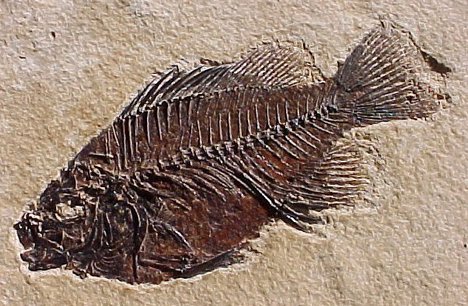


How do we know its age?
Are we speeding up Evolution?
How did we get here? How long did it take?
Variation
Hominids

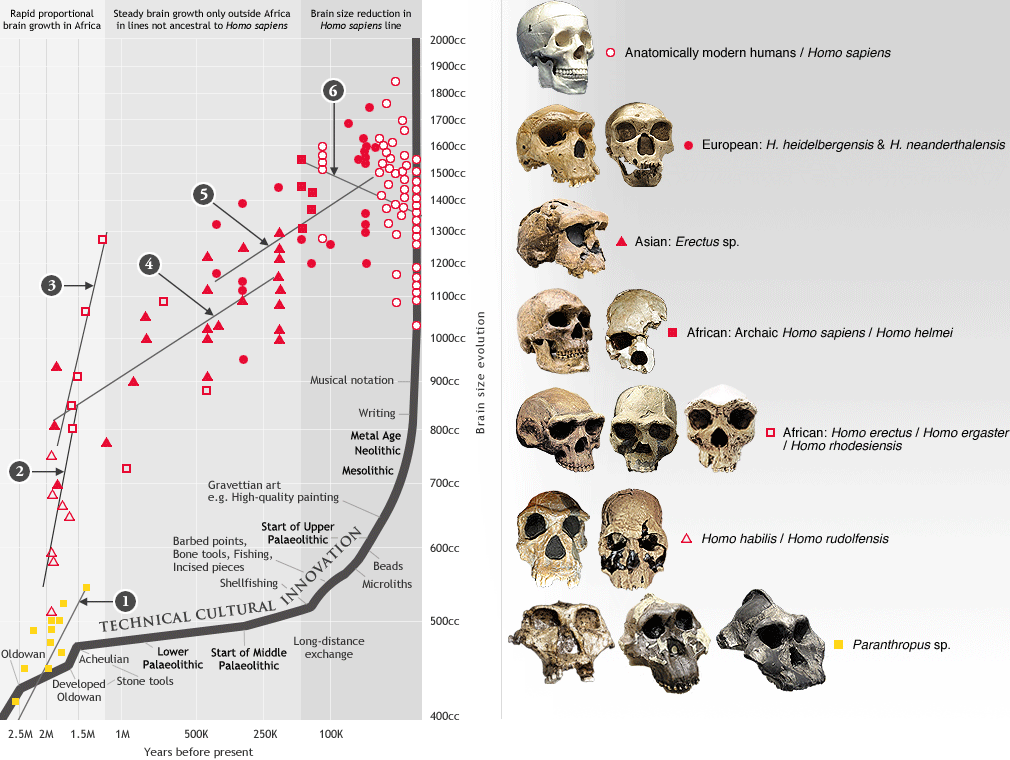

Hominids
How do we know its age?
Are we speeding up Evolution?
How did we get here? How long did it take?
Variation
Natural Selection in Populations
Chapter 11
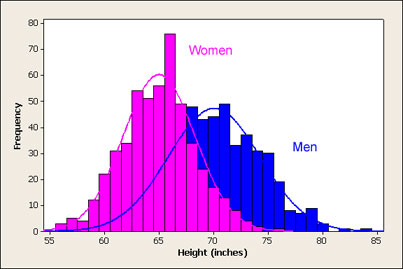
Normal Distribution
Normally when you look at the crowd you can separate people according to height and you put very short people in one side, average height in the middle, and you put very tall people in the other side. You quickly come to the conclusion that there are more average height people than the rest.
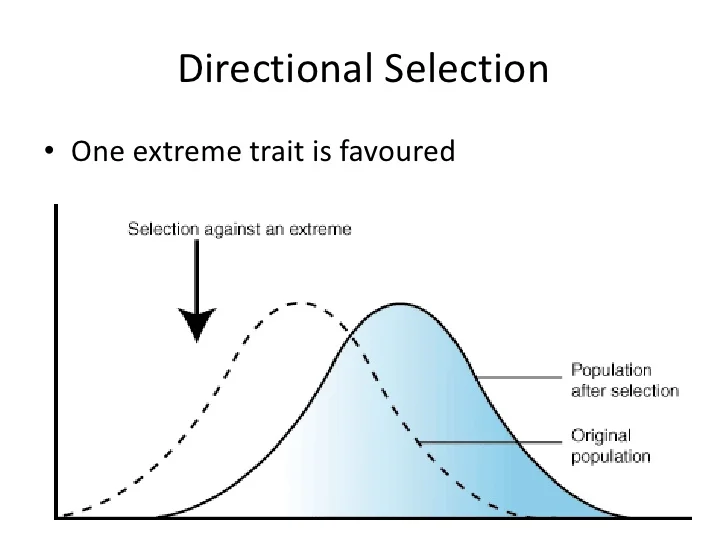
Directional Selection
If nature selects a certain trait to move on then this normal distribution will change towards the direction of the selection.
Stabilizing Selection
When the average phenotype/genotype is favored in a population you also see a change in the overall population.

Disruptive Selection
When the extreme sides of the phenotype/genotype of a population are favored then change to a population is seen as follows....

Mechanisms of Evolution (how groups might evolve)
Speciation: When a new species are created as a result of evolution.
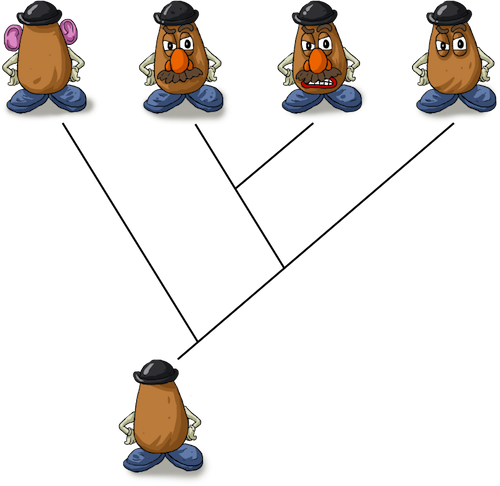
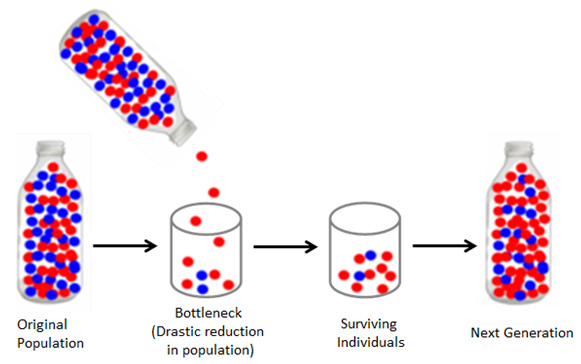
Genetic Drift: A change in the gene pool due to chance.

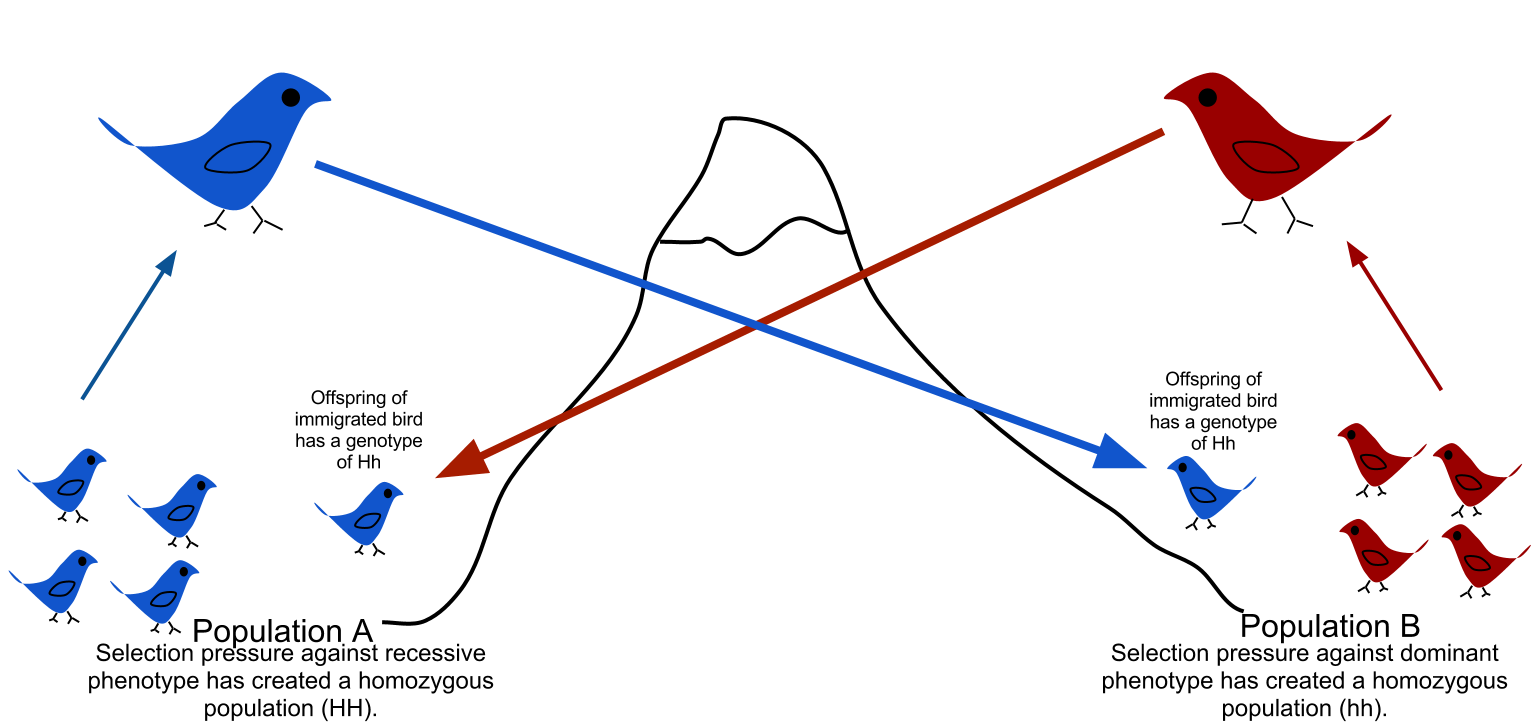
Genetic Flow: When genes from a new population are introduced to an existing population and mating occurs.
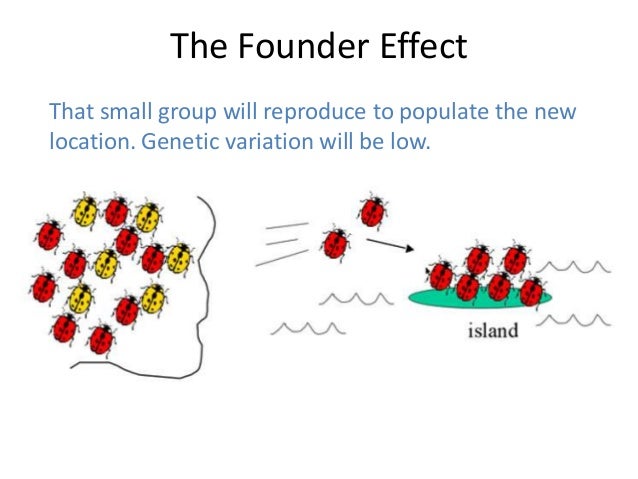
Founder Effect: When a small group of individuals breaks away and starts a new popluation.
Reproductive Isolation: some populations are physically unable to mate or produce a fertile offspring.

Other times different barriers block these species from mating...
Behavioral Isolation: isolation caused by different courtships or mating rituals.

Temporal isolation: isolation due to species not interacting each other because they are active in different seasonal times.